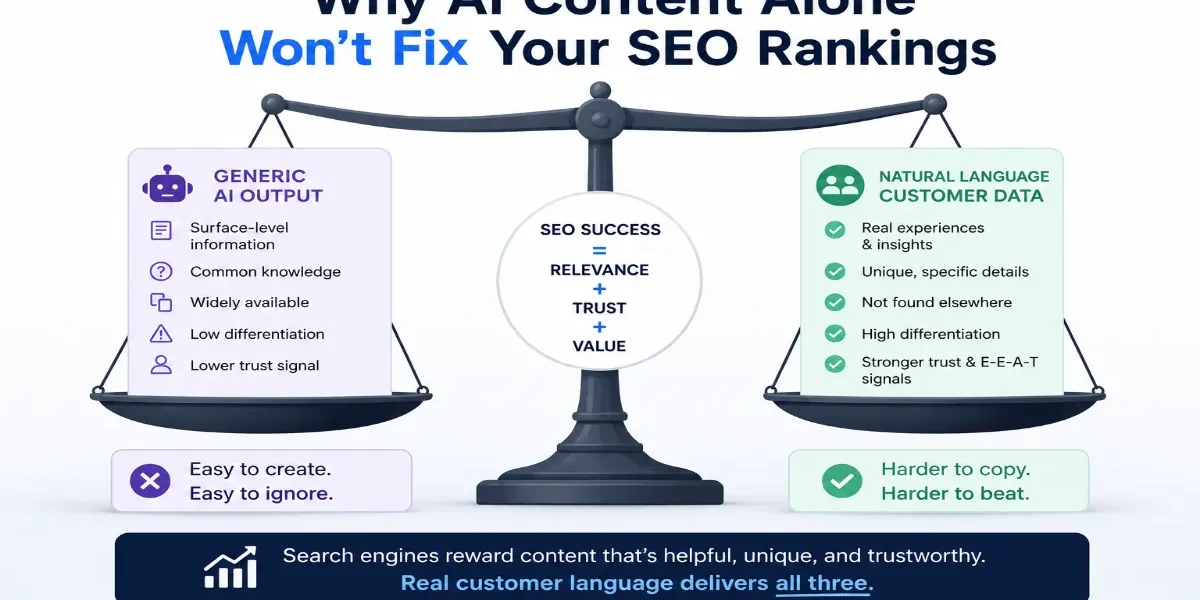
As we navigate through 2026, the tension inside SEO departments is palpable. On one hand, the adoption of artificial intelligence has been a watermark moment for productivity. Content output has skyrocketed. Briefs that once took a day now take an hour. Technical audits that required cross-referencing dozens of spreadsheets are now delivered in minutes. On the other hand, a chilling reality is setting in for many in-house teams and agencies: despite the surge in content, organic rankings are stagnating or, in some cases, declining. The hard truth is that AI Content Alone Won’t Fix Your SEO Rankings.
This isn’t a criticism of the technology itself. Rather, it is a diagnosis of a fundamental disconnect between how we are using AI and how the internet’s largest search engine evaluates content today. The tools are faster, but the strategy is often stuck in a loop of outdated patterns. To fix this, we need to look beyond the output of a large language model and examine the quality of the inputs, the nature of modern search queries, and the operational backbone required to make AI work for SEO—not the other way around.
The Two Simultaneous Crises Facing SEO Teams
To understand why more content isn’t moving the needle, we have to look at two parallel events happening in real-time within most organizations.
How People Search Has Fundamentally Changed
The first crisis is external. The way users interact with search engines has evolved rapidly over the last eighteen months. We are no longer in the era of “best running shoes.” We are in the era of “what are the best running shoes for flat feet that I can use on a wet pavement without slipping.”
This shift is driven by several factors. Voice search continues to grow, even if it’s silent behind a screen. Passage indexing by Google rewards specific answers to specific questions rather than broad overviews. Most importantly, user intent has become hyper-specific. People are searching with full sentences, asking questions directly, and looking for nuanced answers. These are long-tail queries that often exceed ten words. They are conversational. They are natural.
The problem is that most AI models, when simply prompted to “write an article about running shoes,” default to the patterns of the open web. They pull from a training corpus built on years of keyword-stuffed writing. Even if the AI user interface is advanced, the underlying output often mirrors the older, less natural search patterns that Google has already devalued.
The Missing Input: First-Party Data
The second crisis is internal. Most SEO teams have no documented system for feeding their AI tools the right kind of language. You cannot expect a generative AI to produce content that matches natural speech patterns if you do not feed it examples of natural speech from your own customers.
Every SEO team sits on a goldmine of first-party data. This includes call transcripts from sales teams, live chat logs from customer support, reviews left on your site, and questions asked in your community forums. This data is the perfect training material. It is pure, unadulterated natural language straight from the mouths of your target audience. However, this data is rarely organized or structured in a way that the entire department can access. It sits in a CRM, a support ticket system, or a spreadsheet owned by one person.
When you feed AI a generic prompt, you get generic results. When you feed AI your customer’s actual language, you get content that matches how people search today. AI Content Alone Won’t Fix Your SEO Rankings because the AI hasn’t been given the right raw materials to work with.
The Illusion of Productivity Gains
Even if a team solves the input problem, another dangerous bottleneck emerges: fragility. In many organizations, the AI workflow exists inside a single person’s head. It lives as a set of saved prompts in a Chrome extension, or as a specific sequence of commands that one writer knows how to execute. This is what industry experts call a “personal workflow.”
The productivity gain looks real on paper. One person is churning out five times more content than they were a year ago. But the moment that person takes a vacation or moves to a different company, the entire content engine grinds to a halt. The output, the quality, and the workflow disappear with them.
This is not a sustainable operational model. It is fragile, high-risk, and ultimately expensive because it cannot be replicated or scaled without the resident expert.
The 4-Layer AI Ops Playbook for SEO
To solve both halves of this problem—the shift in search behavior and the fragility of personal workflows—a documented, repeatable system is required. Drawing from frameworks used by teams like those at CallRail, a robust system often relies on four distinct layers. These layers ensure that the AI is not just a faster typist, but a strategic asset that operates consistently regardless of who is at the keyboard.
Layer 1: Knowledge
This is the foundation of everything. The Knowledge layer is the repository of your first-party data. It is where you collect and structure the natural language inputs. This includes:
- Customer transcripts: Call recordings and chat logs that show exact phrasing of problems.
- Support tickets: Language used by customers who are confused or seeking help.
- Review data: Positive and negative feedback in the customer’s own words.
- Competitor gaps: Analysis of terms you are missing that competitors are ranking for.
This data must be stored centrally so that every AI prompt draws from the same high-quality, natural-language well.
Layer 2: Workflow
If the Knowledge layer is the “what,” the Workflow layer is the “how.” This is the documented process. It is the Standard Operating Procedure (SOP) for how a content brief is created, how a technical audit is run, or how a rank report is generated.
Instead of telling a writer to “write an SEO article,” the workflow defines the steps: pull data from the Knowledge layer, construct a specific prompt, run the output through a QA checklist, and publish. When the workflow is documented, it does not matter who is executing it. The output is consistent.
Layer 3: Governance
Governance is the layer most teams skip. This defines the rules of engagement. It answers questions like: What percentage of AI-generated text is acceptable? Who has permission to edit the central Knowledge repository? What is the process for fact-checking AI outputs?
Without governance, you risk publishing inaccurate information, contradictory brand messaging, or duplicated content. Governance ensures that the speed of AI does not compromise the quality and trust that Google requires under E-E-A-T guidelines.
Layer 4: Application
The final layer is where the work gets done. This is the actual output—the blog posts, the landing pages, the technical recommendations. When the first three layers are strong, the Application layer is where the team reclaims its time.
Instead of spending hours on repetitive tasks like meta description writing or image alt text generation, the team can focus on higher-value activities: keyword strategy, content planning, and detailed on-page QA. The AI handles the “busy work,” and the human handles the strategy.
Why This System Moves Rankings
When these four layers are implemented and documented, something powerful happens. The AI is no longer writing for the open web of 2020. It is writing for your customer in 2026.
The natural-language data from your Knowledge layer teaches the AI to speak in the same long-tail, conversational tone that Google now prioritizes. The content matches the query intent exactly. This signals to Google that your page is the most relevant answer for that specific question.
Furthermore, because the system is documented, the output is consistent. Google rewards sites that demonstrate consistent topical authority. If every article on your site uses the same high-quality, natural language, your domain authority grows faster than a site that relies on a single “AI whisperer” producing inconsistent work.
A 90-Day Validation Plan
If you are an in-house SEO lead or an agency owner feeling the pressure of justifying your AI tool investment, you do not need to overhaul everything overnight. A targeted 90-day plan can prove the method.
Days 1-30: Choose One Workflow
Do not try to fix everything at once. Pick one specific function. The easiest is often the content brief. For the next month, focus only on improving the quality of your content briefs using first-party data. Pull three customer support calls, transcribe the language used, and feed that into your AI brief generator. Compare the briefs from this method to your old method.
Days 31-60: Document the Process
Now, write down the exact steps you took. Create the SOP. Store it in a shared drive or a project management tool. Teach one other person on your team to run the same workflow. If that person can produce the same quality brief as you, you have successfully moved from a personal workflow to a team system.
Days 61-90: Measure Impact
By the end of the third month, publish a small cluster of articles created by this new system. Track the rankings for the specific long-tail queries you targeted. If you have done the work correctly, you should see movement in the second or third page of the SERPs within 30 days of publication. Present these results to leadership as a proof of concept.
Who Needs to Hear This?
This framework is not for the solo blogger who writes for fun. It is built for the professional SEO lead at a mid-market company, the content marketing manager scaling a blog for a SaaS product, or the agency partner trying to deliver results for SMB clients without hiring ten new writers.
If you have already invested in AI tooling and are struggling to show leadership a return on that investment, the problem is not the tool. The problem is the fuel. You are trying to drive a high-performance engine on low-grade gas.
If you are scaling content output without scaling headcount, you cannot afford to let your processes live in one person’s head. You need a system. You need governance. You need to train your AI on your data.
The message for 2026 is clear: AI Content Alone Won’t Fix Your SEO Rankings. The tools are here to stay, and they are powerful. But their power is unlocked only when combined with a strategic operational foundation that leverages the unique data your brand owns. Stop asking your AI to write for the old internet. Start feeding it the language of your specific customers. That is the path to sustainable ranking growth.
Leave a Reply